Food Safety Intelligence Hub
What Major Retailers Actually Require from Supplier Testing Programs
Ask a supplier what their retailer requires and most will name one thing: a GFSI-recognized certification as a prerequisite for entering their supply chains.
That answer is correct, but it is also incomplete.
A GFSI-recognized certification is the baseline condition for doing business with a major retailer. Major retailers view GFSI standards as the bare minimum framework and layer their own unannounced audits, compliance rules, category-specific safety hurdles, and ongoing testing rights on top of it. Unfortunately, suppliers who treat the GFSI certificate as the end of the conversation are the ones who get caught out at renewal, at audit, or at delisting.
Do major retailers require GFSI certification?
Most major retailers, including Walmart and Costco, expect suppliers to hold a GFSI-recognized certification as a condition of doing business, though the exact rule varies by retailer, product category, and brand type. GFSI does not issue certificates directly. Instead, it benchmarks certification schemes that meet its requirements, and retailers generally accept any of these schemes as proof of a sound food safety system. The main schemes suppliers encounter are SQF, BRCGS, FSSC 22000, IFS, GLOBALG.A.P., and PrimusGFS, each covering different sectors and supply chain stages. GFSI publishes the current list of recognized certification programs.
SQF is one of the most common schemes for suppliers to major US retailers, and manufacturers most often certify to its Food Safety Code (still widely called Level 2) or add its Quality Code (still widely called Level 3).
But certification alone does not close the file. Retailers layer their own requirements on top of it.
Retailers add their own rules on top of GFSI
Costco is a clear example. Costco expects suppliers to hold a GFSI-recognized certification and to add the Costco Addendum, a set of Costco-specific requirements audited alongside the GFSI scheme. That combined audit must be unannounced every year, and sites without a GFSI-recognized certification go through Costco's own unannounced food safety audit instead. A GFSI certificate gets a supplier in the door. It does not exempt a supplier from Costco's own audit.
Walmart follows a similar pattern. Walmart's compliance framework is multi-layered, covering everything from the factory floor to the store shelf. It includes federal and state regulatory compliance, Walmart-specific internal standards, third-party product safety and quality testing, and GFSI-recognized certification for private brand products and higher-risk categories. For national brands outside those categories, Walmart encourages GFSI certification and requires an annual approved food safety audit, and a supplier that lets that audit lapse can lose its vendor number. Depending on the product and a supplier's past performance, Walmart may also require a risk-based site review, and suppliers may need to share verification testing results with Walmart Food Safety on request. Walmart can also sample products at any time to test for authenticity, and it sets extra requirements for higher-risk categories such as deli meats, shell eggs, frozen berries, and raw ground beef.
The pattern behind the requirements
Three things repeat across retailers, whatever scheme a supplier holds:
1. A GFSI-recognized certification is the expected baseline.
No approved certification or audit means no vendor number, in most cases.
2. The retailer's own audit sits on top of the certification.
Costco's Addendum and Walmart's risk-based review are conditions of the relationship. They are the retailer checking its own risk, on its own terms.
3. Ongoing testing does not stop at onboarding.
Retailers keep the right to test, resample, and request data from suppliers throughout the relationship. Audits and sampling often happen unannounced.
For a supplier, this means a testing program built for one certification is not automatically a testing program built for a specific retailer relationship. The certificate proves a baseline system. The retailer's own audit and sampling prove that the system holds up under their specific rules.
Where this leaves supplier testing programs
Most testing programs are built around passing the certification audit once a year. That satisfies the foundation of a product safety program. It does not satisfy the retailer's ongoing right to test, sample, and request documentation. The suppliers who avoid delisting are the ones who treat the retailer's addendum and testing cadence as a standing requirement that runs all year.
Questions to ask about your current program
Before your next retailer audit or renewal, answer these questions:
- Which retailer-specific addenda apply to your accounts, beyond your GFSI certification?
- How would your program respond to an unannounced audit tomorrow?
- Who on your team tracks each retailer's testing cadence separately from the certification renewal date?
- If a retailer requested product testing results directly, how long would it take to produce them?
The bottom line
A GFSI-recognized certification opens the door. It does not keep a supplier on the shelf. Retailers add their own audits, addenda, and ongoing testing rights on top of certification, and a program built only to pass the annual audit will not hold up to that.
This is the gap Genista is built to close: one operating system for product safety, with accredited testing, robotic automation, connected software, and services in one closed loop, instead of stitching together 3+ vendors to keep up with what each retailer actually asks for.

What Food Safety Testing Actually Costs, and Why Most Brands Pay Too Much
Ask a food brand what they spend on food safety testing and they will give you one number: the line item on the lab invoice.
That number is real. It is also incomplete.
The true cost of a food safety testing program has five parts: lab fees; staff time and administrative overhead; the working capital tied up in held product; the cost of the decisions that get made slowly because the data is not available when it is needed; and logistics, retesting, and outsourced scientific services.
Most brands are paying all of these costs. Few are measuring them. And almost none are aware that the fragmented program they built to save money on lab fees is often the most expensive way to run food safety.
The five real costs of a food safety testing program
1. Lab fees
This is the cost most brands track. For a mid-size food or beverage brand, accredited lab fees for routine micro panels, environmental monitoring, and analytical chemistry typically run between $4,000 and $8,000 per month depending on product mix and testing volume.
Lab fees are visible. They show up on invoices. They get approved in budgets. They feel like the cost of the program.
They also tend to bring a second bill with them: separate LIMS and tracking tools to store and manage results, often $1,500 or more per month.
2. Staff time
This is the cost most brands do not track.
Every hour a QA manager or lab coordinator spends pulling results from three portals, reformatting COAs for a retailer submission, chasing chain of custody records, or reconciling data across systems that do not talk to each other is time not spent on science, supplier evaluation, or corrective action analysis.
In programs with 3+ vendors, administrative overhead routinely consumes a third to half of a QA manager's working week. At a fully loaded cost of $80,000 to $120,000 per year for an experienced QA manager, that is $27,000 to $60,000 per year in labor spent on tasks that a connected system largely handles automatically.
3. Working capital tied up in held product
Every day a finished product sits waiting for test results is a day it is not generating revenue.
A brand waiting 5 to 7 days for core panel results holds finished goods in staging for nearly a week before making a release decision. Across a full production schedule, that means significant working capital locked in inventory that cannot move.
For a brand producing $5 million in annual revenue with a 5-day average hold, roughly $45,000 of product is sitting on hold at any given time, valued at cost. For a brand producing $20 million, it is closer to $180,000. That is a material drag on cash flow and a constraint on production scheduling.
4. The cost of slow decisions
When results take days instead of hours, decisions wait.
A supplier showing a borderline result does not get flagged until the next report cycle. A production run that should have been held ships before the result arrives. An audit request due on Friday triggers a three-day documentation scramble starting on Wednesday.
These scenarios reflect the operational reality of a program built around 5-day turnarounds and fragmented data. The cost is real. It shows up in expedited shipments, corrective actions, lost accounts, and, at the extreme end, recalls.
5. Logistics, retesting, and outsourced scientific services
This is the cost category most brands never see on any invoice, because it is spread across multiple departments and never totaled.
Logistics alone carries four hidden cost layers. First, courier management: someone on your team coordinates pickup schedules, routes, and timing across multiple lab vendors. That is staff time billed to operations, not to testing.
Second, shipping costs: most labs charge shipping and handling as a line-item add-on. Across 3+ vendors, those charges multiply without consolidation.
Third, shipping supplies: coolers, ice packs, sample containers, and labels are sourced separately and paid for separately. These small per-shipment costs add up to hundreds or thousands per month.
Fourth, retest costs: when a result comes back questionable (a borderline finding, a chain of custody question, or a failed QC check), the sample must be retested. At fragmented labs, retests mean new courier coordination, new shipping costs, and new wait times. Each retest event costs two to three times the original test fee once logistics are included.
Outsourced scientific services make up the rest of this category. When a brand does not have in-house expertise for regulatory questions, method validation, corrective action analysis, or R&D support, they hire consultants. QA consulting rates typically run $150 to $300 per hour. A single regulatory inquiry or corrective action event can consume 10 to 20 consulting hours. For brands managing this reactively across a fragmented program, annual consulting costs routinely reach $20,000 to $60,000.
A connected managed services program takes these costs off the books. Courier management, shipping, and supplies are included in the monthly flat fee. Retests are free. Scientific expertise is available as part of the service. What used to be scattered across departments and invoices becomes one predictable line item.
The brands paying the most for food safety testing are often the ones who never added up all five costs.
Why fragmentation makes every cost higher
Most food brands did not design a fragmented testing program. They built one incrementally, adding a lab here, a software tool there, a logistics coordinator when volume increased.
Each addition made sense at the time. Together, they create a system where:
- Lab fees are spread across multiple vendors with no volume consolidation or pricing advantage
- Shipping, supplies, and retests are billed separately by every lab
- Staff time multiplies because every portal, format, and contact requires a separate interaction
- Held product accumulates because turnaround times vary across vendors with no single SLA
- Decisions slow down because data lives in systems that do not connect
The fragmented program that looks like it is saving money on lab fees is typically spending those savings, and more, on the five costs above.
What a connected program costs, and what it saves
A connected food safety program, one where accredited testing, logistics, software, and managed services run through a single platform, changes the cost structure at every level.
Lab fees
Consolidated volume means consolidated pricing. One vendor relationship with one contract and one monthly flat fee replaces separate invoices from 3+ labs. Pricing is predictable. Budgeting is straightforward.
Software
Separate LIMS and tracking tools are no longer needed. Results, supplier records, and documentation live in one system that comes with the program.
Staff time
In a fragmented program, testing admin can take a third to half of a QA manager's week. When results flow automatically into a connected system, most of the administrative work disappears. No portal switching. No format reconciliation. No chasing documentation. QA managers can spend that time on decisions instead of data retrieval.
Working capital
Next-day results on most tests mean hold decisions get made the next day instead of the following week. Product moves faster. Cash flow improves. For a $10M brand holding product five days, cutting that to one day frees up roughly $70,000 in inventory at cost. Production scheduling becomes more flexible.
Logistics and retesting
Courier management, shipping, supplies, and retests are all included in the monthly flat fee. Retests are free. QA expertise is built into managed services instead of billed as outside consulting. No courier coordination. No surprise retest invoices.
Decision speed
When all results, supplier history, corrective actions, and chain of custody records live in one place, the answer to any question is available immediately. Audit requests get answered in minutes. Flagged results
trigger same-day responses. Borderline trends are easier to see before they become incidents.
The math most brands have not done
Here is a simplified comparison for a mid-size food or beverage brand:
Fragmented program (3+ vendors)
Lab fees: $4,000–$8,000/month across multiple vendors
Software: $1,500+/month in separate LIMS and tracking tools
Staff time overhead: $2,200–$5,000/month (a third to half of QA manager time)
Working capital drag: $90,000+ in product sitting on hold at any time (varies by revenue and hold time)
Logistics, retesting & consulting: $2,500–$8,000+/month (courier management, shipping supplies, retest fees, outsourced QA expertise)
Decision delays: unquantified but real. Slower response, higher recall risk.
Connected program (one platform)
One monthly flat fee: $3,000–$8,000/month (all-in, including shipping, supplies, and retests)
Software: Included. One system for results, tracking, and records
Staff time overhead: Minimal. Automated result flow, one portal, one contact
Working capital drag: Significantly reduced with next-day results on most tests
Logistics, retesting & consulting: Included in the monthly flat fee. Retests are free.
Decision speed: Next-day results on most tests, one system, immediate visibility
Questions to ask about your current program
Before your next budget cycle, answer these questions:
- What percentage of your QA team’s time goes to administrative tasks such as pulling data, reconciling formats, chasing documentation?
- How many days does finished product sit in staging waiting for test results before a release decision?
- How many separate lab portals, invoices, and contacts does your team manage?
- When an audit request arrives, how long does it take to produce the full documentation package?
- What is the total cost of your testing program when you include staff time and held product in addition to lab fees?
If those numbers are difficult to calculate, that is itself an answer.
The bottom line
Lab invoices are only one line item in a larger cost structure that most brands have never fully measured.
The brands that measure it discover that consolidating to a connected testing platform, with one monthly flat fee, free retests and shipping, next-day results on most tests, and automated data flow, does not cost more than the fragmented alternative.
In many cases, it costs less and delivers more. That is the math most brands have not done yet.
EMP Zone Mapping: Where Most Monitoring Programs Have Blind Spots
Your environmental monitoring program runs on a schedule. Swab Zone 1 on Monday. Swab Zone 2 on Wednesday. Rotate through the facility on a fixed calendar.
The schedule looks thorough and on paper, it covers every zone.
Unfortunately, pathogens do not follow a schedule.
A fixed EMP calendar was built for compliance, not for finding risk. It documents that swabbing did happen, but it does not always find what is actually lurking in the dark.
What EMP zones are and why they matter
Environmental monitoring programs divide a facility into zones based on proximity to product contact.
- Zone 1: direct product contact surfaces. This is the highest-risk zone. Examples include conveyor belts, filling equipment, and cutting boards.
- Zone 2: surfaces adjacent to Zone 1. These surfaces do not touch the product directly. But contamination here can transfer to Zone 1. Examples include equipment frames and drip shields.
- Zone 3: areas near the production environment but not adjacent to product contact. Examples include walls, floors near processing lines, and drains.
- Zone 4: areas outside the production environment. Examples include hallways, locker rooms, and loading docks.
Most regulatory guidance and retailer audit standards require sampling in all four zones. The frequency and number of samples differ by zone.
The problem with fixed-schedule EMP
A fixed schedule assigns specific zones to specific days. The team swabs the same locations on the same rotation every week.
However, this approach has a serious flaw because pathogens can adapt to predictable patterns.
Listeria monocytogenes is the most documented example. Studies show that Listeria can establish harborage points in locations that a fixed schedule never hits on consecutive days. The rotation cleans the surface just often enough to suppress the count. But it never eliminates the source.
The result: results come back clean. The harborage point remains.
This is not a failure of the team but a failure of the program design.
A monitoring program that does not find the problem is not a monitoring program. It is documentation.
Four blind spots most EMP programs create
1. Over-sampling safe zones
Fixed schedules often sample low-risk zones more than necessary. Zone 4 locations are easy to access and rarely show positive results. They build a record of clean data. But they do not reduce risk where risk actually exists.
2. Under-sampling high-risk zones
Zone 1 and Zone 2 are the most important areas to monitor. But they are also the hardest to access. Fixed schedules sometimes reduce sampling frequency in these zones because of operational constraints. This creates the highest-risk blind spot in the program.
3. Predictable patterns that pathogens learn
When a fixed schedule always swabs the same location on the same day, the cleaning cycle adjusts to match. Counts stay low enough to pass. The harborage point never triggers a flag. The program shows compliance. The facility is not actually clean.
4. Missing high-risk micro-locations
Floor drains, equipment bases, conveyor junctions, and staging areas are common Listeria harborage points. A fixed schedule often skips these locations or samples them infrequently. They are not labeled as high-risk in the original program design. But experience shows they are.
What a risk-based EMP program does differently
A risk-based EMP program does not replace the schedule entirely. It adds intelligence to the schedule.
Here is what that looks like in practice:
- Risk-weighted zone mapping: sample more frequently in high-risk zones. Reduce frequency in low-risk zones. Base the allocation on historical data, facility layout, and product type, not on what is convenient to access.
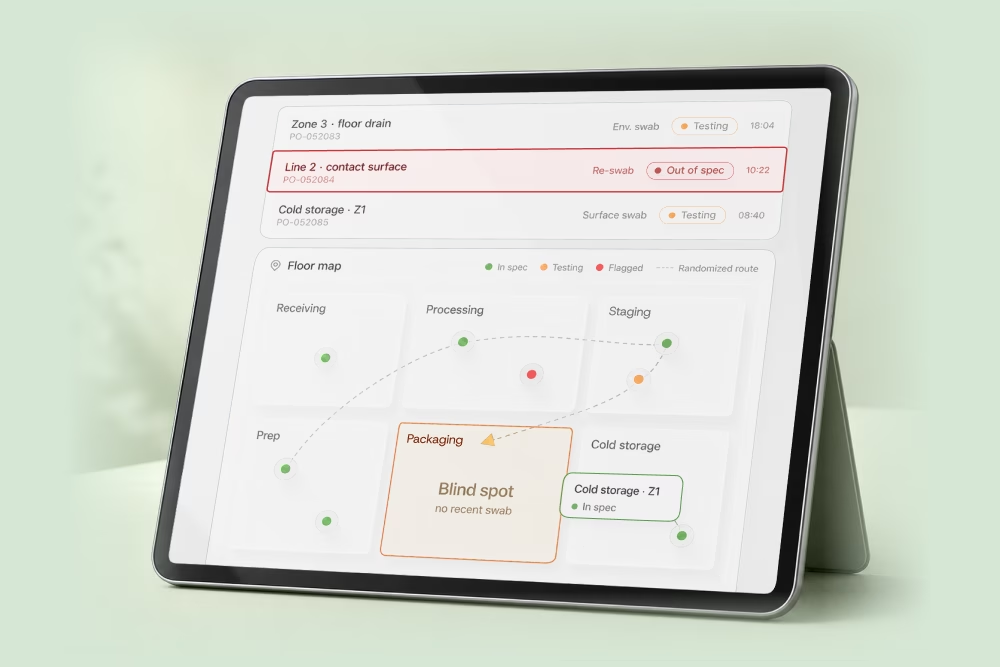
- Automated randomization: use a system that randomizes sample locations within each zone. The schedule changes week to week. Pathogens cannot establish a pattern around a predictable rotation.
- Trend analysis: track every result over time by zone, location, and date. Look for patterns. A zone that shows borderline results three times in a row is a signal. A fixed-schedule program rarely surfaces this because the data lives in separate reports.
- Real-time alerts: when a result comes back out of spec, the response begins immediately. Not at the next scheduled review. Not after the weekly report is compiled. Immediately.
- Harborage investigation protocols: when a positive result appears, the program has a defined process for expanding sampling around that location. The goal is to find the source, not just clean the surface.
Together, these elements shift EMP from a documentation exercise to an active risk management tool.
How the data changes what you find
The difference between a fixed-schedule EMP and a risk-based EMP shows up most clearly in what each program finds.
- Fixed-schedule programs tend to find contamination after it has already spread. A positive result in a high-risk zone often means the pathogen has been present for some time. The schedule was not hitting the right location at the right frequency to catch it earlier.
- Risk-based programs tend to find contamination earlier. Randomization and trend analysis surface signals before they become positive results. A borderline pattern in a Zone 2 location triggers investigation before the count crosses the threshold.
Earlier detection means earlier response. Earlier response means less product at risk, fewer corrective actions, and a lower probability that a contamination event becomes a recall.
What to look for in your current program
Review your current EMP program against these questions:
- Does the program sample Zone 1 and Zone 2 at a frequency appropriate to your product risk category?
- Does the schedule randomize sample locations, or does it hit the same spots on the same days every week?
- Do you have a process that tracks results by location over time and flags deteriorating trends?
- When a result comes back out of spec, how long does it take to initiate an investigation?
- Does the program include floor drains, equipment bases, and staging areas as defined sample locations?
If the answer to any of these is no, or uncertain, that is where the blind spot is.
The bottom line
Environmental monitoring is one of the most important tools in food safety. It is also one of the most commonly underbuilt programs in the industry.
A schedule is a starting point. A risk-based program is the actual tool.
The goal is not to document that swabbing happened. The goal is to find what is actually there before it reaches your product.
A program built to find risk is different from a program built to document compliance. Both look the same on paper. Only one works when it matters.
30 Days to Prove Their Product Was Safe. Here Is How They Did It.
Note: The scenario below is illustrative. It is based on common challenges Genista helps supplement brands navigate. Specific details, timelines, and outcomes are representative of real program types, not a single documented customer story.
The email arrived on a Tuesday. A major natural grocery retailer had reviewed the brand. They loved the pitch and the product, and were interested in moving forward.
But, before the follow-up meeting, the buyer needed one thing. They needed a complete testing document package that measured potency, purity, label accuracy, and accredited COAs for every active SKU.
The brand had 30 days.
The problem: they did not have any of it.
The gap most emerging brands do not know they have
This brand was not cutting corners. They had a quality program. They tested their products in their contract manufacturer's in-house lab. This is common for brands at their stage.
Most brands do not find this gap until a retailer asks a question the brand cannot answer. The question was simple: does the laboratory hold ISO/IEC 17025 accreditation, and are the relevant methods within its accredited scope?
The answer was no.
Contract manufacturer labs are often competent. But competent is not the same as independently verified.
Some retail buyers may require results from an independent accredited laboratory, depending on their program and product requirements. Label claim accuracy and contamination risk are under close regulatory and consumer review.
When a retailer requires accredited independent testing, the supporting documentation becomes part of the qualification process.
The question was not whether their product was safe. It was whether they could prove it to someone with no reason to take their word for it.
What 30 days actually looked like
In this scenario, the brand comes to Genista with a clear task – to run the full test suite on their top SKUs. Deliver accredited COAs. And, do it all before the buyer meeting.
Here is what the illustrative timeline could look like from intake to result:
- Days 1-2: Sample intake and panel selection. We reviewed every active SKU. We matched the right panels to each product label. Panels included potency, purity, label accuracy, heavy metals, microbiology, and allergen screens.
- Days 3-5: Sample processing. High-throughput robotic automation processed all SKUs at the same time. There were no bottlenecks. We did not wait for one panel to finish before starting the next.
- Days 6-12: Analysis and review. Real-time PCR, analytical chemistry, and microbiology panels ran at the same time. Qualified scientists reviewed each result against the applicable label claims and regulatory criteria.
- Day 13: First results delivered. COAs were prepared. Chain of custody documents were completed for the first group of SKUs.
- Day 21: Full test package complete. Every active SKU was tested. All COAs from the accredited laboratory were ready. Documents were formatted for retailer submission.
In this illustrative timeline, the package is complete nine days before the deadline.
By the numbers:
100% of SKUs tested • 21-day turnaround vs. 60+ days at traditional labs • Retailer account secured
What the testing could reveal
Most results came back clean but not all of them. Two SKUs show label accuracy discrepancies. The declared potency on the label did not match the analytical result.
This was not a safety issue, it was a compliance issue. A retailer or regulatory review could raise questions about the discrepancy.
The brand had two options. They could reformulate before the buyer meeting. Or they could update the label to show the actual potency.
They chose to update the label. They worked with their regulatory team and filed the updated label. They walked into the buyer meeting with accurate documents.
Finding the discrepancy before the meeting gives the brand time to address it.
A label problem found in a retailer audit after placement means a corrective action. It may mean a delisting, and it may create a brand reputation problem. If found before placement, it is fixable.
Why this pattern is common
This type of documentation gap can emerge during retail expansion. It is widely common for most emerging supplement and food brands when they begin retail expansion.
The testing gap exists for a clear reason. Brands build quality programs around production, not around retail qualification.
They test what they need to manufacture safely. They do not always test what a major retailer's quality team will require, not until the retailer asks.
Brands that handle retail expansion well close this gap before the buyer meeting, not during it.
They build accredited independent testing into their quality program early. The documents exist when needed, not built under a deadline.
The cost of doing this early is predictable. The cost of doing it late is higher. The cost of not doing it is losing an account or damaging the brand’s reputation.
What a retail-ready test package requires
For supplement brands, a complete retail-ready test package includes:
- Potency testing: verify active ingredient levels against label claims using validated analytical methods
- Purity testing: confirm the absence of contaminants, adulterants, and undeclared substances
- Microbiology: run pathogen screening and total aerobic count for the product category
- Heavy metals: screen for lead, arsenic, cadmium, and mercury against California Prop 65 and USP limits
- Allergen screens: confirm that undeclared allergens are absent at detection limits
- Label accuracy: compare declared amounts on the label against analytical results
Every panel must come from an ISO/IEC 17025-accredited laboratory that uses methods validated for your specific product. The lab must document the chain of custody from sample receipt to result delivery.
A defensible COA reflects both the reported result and the documented process behind it.
The bottom line
Shelf placement at a major natural grocery retailer is one of the most valuable outcomes for a supplement brand.
The brands that get there and stay there have documents that hold up to review. Not just at the buyer meeting but in every audit, every renewal, and every regulatory review that follows.
Accredited testing is not the finish line. It is the foundation of everything that follows.
The point of this illustrative scenario is not that testing guarantees a retail account. It is that accurate, complete documentation can help a brand enter the review process prepared.
When You Change the Formula, Does Your Testing Program Know?
Your R&D team reformulates a product. They use a new ingredient. The cost is better. The label is cleaner. The change makes sense commercially, operationally, and competitively.
But, the lab doesn’t get the memo.
In many food companies, reformulations are managed through R&D, procurement, and operations. The testing program keeps running the same panels on the same schedule, and often doesn’t get updated until something goes wrong.
This disconnect can leave a preventable gap between the product being made and the risks the testing program evaluates.
Why reformulations create new risk
A formulation change can alter the safety and stability profile of your product. The new profile may need different tests, different methods, or different test frequency. (21 CFR § 117.170)
Here’s why:
- New ingredients can introduce different microbial, chemical, or allergen considerations. A new supplier may use different facilities, sourcing practices, or controls that change the ingredient’s hazard profile.
- New ingredient combinations can change allergen-control and labeling requirements. You add a nut oil or plant protein. The existing testing and verification plan may no longer address the relevant allergen considerations.
- New processing steps change shelf life. A new formula may change moisture, water activity, or pH. The existing shelf-life evidence may no longer represent the reformulated product.
- New suppliers require qualification against the organization’s risk-based criteria. Existing supplier documentation, history, or verification may not be sufficient for the new source.
None of these risks are obvious from a label change. They only become visible when you look at the formulation change through a food safety lens.
You changed what you’re making. Does your testing program know?
How the gap typically plays out
We see this pattern often.
Step 1: The team approves the formula change.
R&D signs off. Procurement sources the new ingredient. Operations updates the production line. The change is logged in the product management system.
Step 2: The testing program doesn’t change.
The lab runs the same panels as before. No one tells QA about the new formula. The QA team may not know until they see the updated spec sheet.
Step 3: Product ships.
Several production runs go out under the new formula. Results come back clean. But the tests look for risks from the old formula, not the new one.
Step 4: A problem appears.
A retailer review identifies an allergen-control or labeling gap that the change process did not address. A consumer complaint triggers an investigation. Or a contamination event reveals that the new ingredient brought a pathogen risk no one verified.
A gap that was fixable during change control becomes a release, audit, or investigation problem later.
Three formulation changes that warrant close review
1. Ingredient supplier changes
The microbial and chemical hazard profile may differ when the same ingredient comes from a new supplier.
A supplier change is both a procurement decision and a food-safety decision. Review the new source before production and determine what documentation, qualification, or independent testing is warranted.
2. Ingredient category changes
You add or swap an ingredient into a new category. For example: a plant protein, a fermented component, or a raw agricultural ingredient.
These ingredients introduce risk categories your current panel may not cover. The change should trigger a documented review of the testing panel, methods, specifications, and relevant controls.
3. Process changes that affect water activity or pH
Some formula changes alter the moisture content, acidity, or water activity of your product.
These changes affect microbial stability. A product that was shelf-stable before may behave differently now. The significance of the change depends on the product, process, formulation, packaging, and intended storage conditions.
What a connected testing program does differently
Organizations that manage formula risk well share one thing: their testing program connects to their product development process.
In practice, this means:
- Formula changes can automatically trigger a documented testing review. When someone updates the formula, a flag appears on the testing protocol. The workflow assigns the review without relying on an informal handoff.
- New ingredients initiate a supplier-verification review. Before a new ingredient enters production, the team determines whether independent testing is warranted and confirms that the selected laboratory and method are appropriate. The result is documented before the first batch runs.
- Testing panels are reviewed against the new formula. The tests running on a reformulated product reflect what is actually in it today, not two years ago.
- Results are visible in one system. QA, R&D, and operations can access the testing status and approved records before the release decision.
This is not a technology problem. It is a systems problem. The necessary information often exists, but the workflow does not consistently connect it.
The question worth asking before the next reformulation
Before your next formulation change goes into production, ask:
- Has the testing program been reviewed against the new formula?
- If there is a new ingredient supplier, has the team documented the qualification and any independent testing warranted by the risk review?
- Are the panels running on this product still appropriate for what’s actually in it?
- Does QA have visibility into the change before product ships, or after?
If the answer to any of these is “I’m not sure,” that is the gap.
Reformulations are a normal part of building a food brand. A missed testing-program review does not have to be.
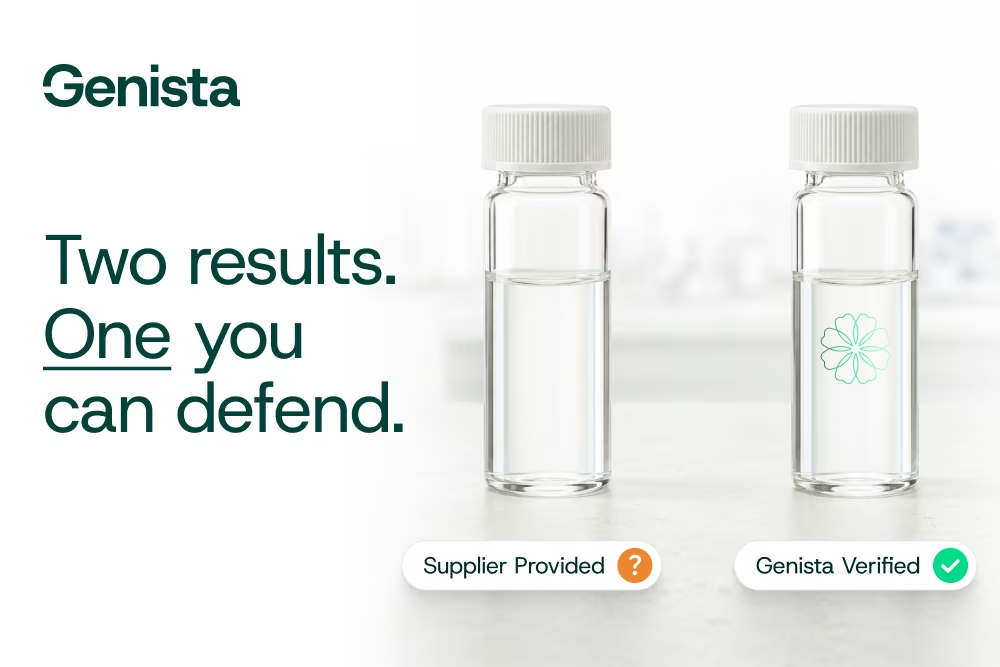
Your Supplier Says It’s Safe. But Who’s Checking?
Every food brand has a supplier. Most have dozens.
And most of those suppliers send along test results with every shipment. A certificate of analysis showing the ingredient is within spec. A microbial screen confirming no pathogens detected. A potency report backing the label claim.
The paperwork looks right. The numbers are there. The box gets checked.
What almost nobody asks: who ran that test?
The supplier COA problem
Supplier-provided COAs are everywhere in the food industry. They’re standard practice, expected by buyers, and seemingly rigorous. But “supplier-provided” is doing a lot of work in that phrase.
Here’s what supplier testing often actually means:
- An in-house lab with no independent accreditation: the supplier built a lab, hired technicians, and ran tests on their own product. There is no external verification of their methods, equipment, or data integrity.
- A third-party lab with a long-standing supplier relationship: the supplier contracts with a lab they’ve worked with for years. That lab depends on the supplier’s business. The financial relationship creates an implicit incentive to produce clean results.
- Methods not validated for your specific matrix: accreditation covers specific test methods applied to specific product types. A method validated for one matrix may not be appropriate for another — but the COA won’t tell you that.
- No chain of custody: the sample travels from the supplier’s facility to their lab with no independent documentation of how it was handled, stored, or processed before testing.
None of this means supplier testing is fraudulent. Most of it isn’t. But it means the result is unverified — and in food safety, unverified isn’t good enough.
Your supplier says it’s safe. The question is whether anyone independent has verified that.
What “independent verification” actually means
Independent verification means a lab with no financial relationship to your supplier, operating under ISO/IEC 17025 accreditation, running validated methods on a sample with a documented chain of custody.
That combination matters for a specific reason: it removes every structural incentive for the result to be anything other than accurate.
The accreditation body doesn’t care whether the result is clean or flagged. The independent lab doesn’t have a contract renewal on the line. The chain of custody ensures the sample that was tested is the sample that shipped.
That’s a fundamentally different kind of result than a supplier COA — even when both show the same number.
Three situations where the difference becomes critical
1. A retailer qualification
Major retail buyers — Whole Foods, Costco, Target, and others — increasingly require independent, accredited test data as a condition of shelf placement or SKU approval. Supplier COAs don’t qualify. Brands that have been relying on supplier-provided documentation often discover this gap at the worst possible moment: when a buyer asks for accredited results and the brand doesn’t have them.
2. An FDA inspection
FDA investigators reviewing a food safety program don’t just look at whether testing was done. They look at who did it, how, and whether the process was independently verified. Supplier-provided COAs from unaccredited labs carry significantly less weight in an inspection than results from an independent, ISO 17025 accredited facility. In a consent decree or warning letter scenario, this distinction can be the difference between a manageable finding and a major enforcement action.
3. A contamination event or recall
When a product is implicated in an illness event or regulatory action, the entire testing record gets scrutinized. Plaintiff attorneys, FDA investigators, and insurance adjusters all ask the same question: was this testing independent and defensible? Supplier COAs from in-house labs don’t pass that test. The brand that relied on them is now in the position of defending results generated by the same entity that had a financial interest in producing them.
The most common scenario we see
A mid-size food or supplement brand has been purchasing ingredients from the same supplier for three to five years. The supplier sends COAs with every shipment. Results are consistently clean. The QA team files them, the procurement team is satisfied, and nobody asks questions.
Then one of the following happens:
- A major retail buyer requests accredited independent test data for a new SKU review
- The FDA issues a warning letter to the supplier — which triggers scrutiny of every brand purchasing from them
- A consumer complaint triggers an internal investigation that reveals the brand has no independent verification of any ingredient claims
At that point, the brand is starting from zero. They need to re-test every active SKU, rebuild their documentation, and explain to buyers and regulators why they were relying on supplier-provided data without independent verification.
That process takes months and costs significantly more than an independent testing program would have.
What independent verification looks like in practice
At Genista, independent verification means your ingredient or finished product sample is tested by an ISO 17025 accredited lab with no relationship to your supplier — using validated methods appropriate for your specific matrix, with full chain of custody documentation from receipt to result.
For brands that source from multiple suppliers, we build ongoing independent verification into the testing program: every supplier, every shipment category, on a cadence calibrated to risk level and production volume.
The result is a testing record that holds up to a retailer audit, an FDA inspection, or a legal proceeding — because it was built to be defensible, not just to check a box.
The question worth asking today
For every ingredient in your supply chain, ask: if the FDA showed up tomorrow and asked to see independent, accredited verification of this supplier’s results, could you produce it?
If the answer is no — or “I think so” — that’s worth addressing before it becomes urgent.
Independent verification isn’t a redundancy. It’s a second opinion with credentials. And in food safety, that distinction is everything.

The Real Cost of a Food Recall (It’s Not the Fine)
The call comes on a Tuesday. A retailer has flagged a product. The FDA is asking questions. Someone in your supply chain has a positive pathogen result.
By Friday, you’re in full recall mode.
Most conversations about food recalls focus on the regulatory fine. It’s the number that shows up in news coverage, the figure legal teams worry about. But for the mid-size food and supplement brands we work with, the fine is rarely what does the most damage.
The damage comes from everything else.
The real cost structure of a food recall
Here’s what a recall actually costs a mid-size brand — broken down by category:
1. The regulatory fine
FDA penalties for food safety violations typically range from $10,000 to $500,000+, depending on the nature and scope of the issue. For a willful violation or repeat offense, civil monetary penalties can exceed $1 million.
This is the number everyone talks about. It’s also, in most cases, the smallest line item on the total damage ledger.
2. Product destruction and logistics
Every unit of recalled product has to be located, retrieved, and destroyed. For brands with broad retail distribution, this means coordinating reverse logistics across dozens or hundreds of locations. Third-party logistics providers charge for this. So do retailers.
For a mid-size brand with 500,000+ units in distribution, product destruction and retrieval costs routinely exceed the regulatory fine by a factor of three to five.
3. Retailer chargebacks and penalties
Major retailers have supplier agreements that include penalty clauses for recalls. These chargebacks cover the retailer’s cost of pulling product, notifying customers, managing returns, and handling any reputational exposure on their end.
These penalties are often non-negotiable and are deducted directly from future invoices. For brands that sell through Whole Foods, Costco, Target, or similar, a single recall chargeback can run into six figures.
4. Lost shelf space
This is where permanent damage begins. Retailers don’t always take a brand back after a recall. When they do, the reinstatement process can take 6 to 18 months — requiring new documentation, new buyer relationships, and sometimes a complete product reformulation.
During that window, a competitor fills the shelf. Consumers find alternatives. The brand’s position in that category erodes.
5. Internal productivity loss
A recall doesn’t just affect QA. It pulls in operations, legal, finance, marketing, and executive leadership simultaneously. For a team of 50 people, a major recall can consume the equivalent of 3 to 6 months of productive capacity across departments.
That’s capacity not spent on new product development, sales, or growth. It’s an opportunity cost that never shows up on the recall ledger but is very real.
6. Brand equity erosion
Consumer trust takes years to build and days to lose. Research on food recall impacts consistently shows that brands experience a 15–30% decline in category sales following a high-visibility recall, with full recovery — if it happens at all — taking two to five years.
For emerging brands, a recall at the wrong moment can be fatal. For established brands, it can set back years of brand equity investment.
The fine is the part people talk about. It’s not the part that hurts most.
What the total damage actually looks like
Put it together for a hypothetical mid-size food brand with $50M in annual revenue and broad retail distribution:
- Regulatory fine: $50,000–$250,000
- Product destruction and logistics: $150,000–$500,000
- Retailer chargebacks: $100,000–$400,000
- Lost shelf space (12-month revenue impact): $500,000–$2M+
- Internal productivity loss: $200,000–$600,000
- Brand equity and marketing recovery: $300,000–$1M+
Total exposure: $1.3M–$4.75M+
From a $50,000 fine.
The recalls that shouldn’t have happened
The FDA reported more than 800 food recalls in the United States last year. The majority fall into three preventable categories:
- Undeclared allergens: a labeling or formulation issue that accredited ingredient testing would have caught
- Pathogen contamination: Listeria, Salmonella, or E. coli detected after distribution that environmental monitoring and incoming ingredient testing should have identified
- Foreign material: a quality control failure in the production process
These aren’t acts of negligence. They’re failures of infrastructure — testing programs that weren’t rigorous enough, results that came back too slowly to act on, data that lived in siloed systems instead of one connected view.
What prevention actually requires
Prevention isn’t just more testing. It’s the right testing, fast enough to act on, with documentation that holds up if something goes wrong anyway.
That means:
- ISO 17025 accredited methods that produce legally defensible results, not just numbers on a page
- Next-day turnaround that lets QA teams make hold/release decisions before product ships — not after
- Environmental monitoring programs designed to find harborage points, not just confirm clean zones
- Connected data systems that surface patterns across suppliers, facilities, and time — so risk signals are visible before they become incidents
- Audit-ready documentation that doesn’t require a three-day scramble when an investigator shows up
Most brands are running some version of a food safety program. The question is whether it’s built for prevention or just for compliance.
The math is straightforward
A comprehensive, accredited food safety testing program for a mid-size food brand typically costs $3,000–$8,000 per month on a managed services model.
The low end of a preventable recall costs more than five years of that investment.
The brands that treat food safety testing as a cost center are doing the math wrong. It’s a risk management function. And the risk it manages — a recall, an audit finding, a lost retail account — is orders of magnitude more expensive than the program itself.
The bottom line
Recalls are not random events. They are, in most cases, the downstream consequence of gaps in testing rigor, result speed, and data visibility.
Closing those gaps doesn’t require a massive operational overhaul. It requires the right partner — one that combines accredited science, automated throughput, and connected software into a single system built for the way food production actually works.
The cost of getting food safety right is predictable. The cost of getting it wrong is not.

The Vendor Fragmentation Problem: Why Managing Food Safety Across Multiple Providers Is a Systemic Risk
The average mid-size food brand manages its product safety program across three to five separate vendors.
A lab for microbiology testing. A different lab for analytical chemistry. A software platform for tracking results. A logistics coordinator for sample pickups. A consultant for regulatory questions.
Each vendor was chosen carefully. Each fills a legitimate need. And together, they add up to a food safety program that feels comprehensive because it has all the pieces.
What it doesn’t have is a system.
What fragmentation actually looks like
Fragmentation isn’t a single failure. It’s the cumulative effect of building a food safety program piece by piece, vendor by vendor, over time.
Here’s what it looks like in practice:
- Results live in multiple portals: Lab A has one login. Lab B has another. The software platform has a third. Getting a complete picture of your testing status means checking three systems — manually, every time.
- Each vendor has a different contact: when something goes wrong, you’re making calls. The lab contact doesn’t know about the logistics issue. The logistics coordinator doesn’t have visibility into the result. Nobody owns the full picture.
- Invoices and contracts multiply: three vendors means three contracts, three billing cycles, three renewal conversations, and three sets of terms to manage. Administrative overhead that compounds over time.
- Data doesn’t connect: results from Lab A aren’t visible alongside results from Lab B. Trend analysis across suppliers, facilities, or time periods requires manual data extraction and reconciliation. Most QA teams don’t have bandwidth for that — so it doesn’t happen.
- Response time slows: when a result comes back flagged, the clock starts immediately. In a fragmented system, the first thirty minutes are spent figuring out who to call, which system has the relevant history, and whether the logistics vendor can get a re-sample in time.
Each of these problems is manageable in isolation. Together, they create a food safety program that is slower, less visible, and harder to defend than it needs to be.
Fragmentation doesn’t feel like a risk. It feels like thoroughness. That’s what makes it dangerous.
The hidden cost of the scramble
The most visible cost of fragmentation shows up in a crisis. A result comes back flagged on a Friday afternoon. Here’s what the next two hours look like in a fragmented program:
- Call the lab to understand the result. Wait for a callback.
- Log into the software platform to pull historical results for that supplier. Realize the platform only shows results from one of the two labs you use.
- Email the logistics coordinator to find out when the sample was picked up and how it was stored in transit.
- Call the consultant to ask whether this result triggers a regulatory notification obligation.
- Attempt to piece together a timeline from four different sources, none of which talk to each other.
The result itself may be manageable. The two hours spent figuring out who has what information is pure operational waste — and in a food safety incident, two hours matters.
Where fragmentation creates legal and regulatory exposure
The operational costs are significant. The legal and regulatory costs are potentially worse.
Chain of custody gaps
In a fragmented program, chain of custody — the documented record of how a sample was handled from collection to result — is often split across vendors. The lab has the analytical record. The logistics provider has the transport record. If they’re not connected, the chain has gaps. In a recall investigation or FDA audit, those gaps are findings.
Audit documentation scrambles
When a retailer or regulator requests documentation, the fragmented brand has to pull records from multiple systems, reconcile formatting differences, and hope nothing falls through the cracks. What should take an hour takes three days. During that window, the brand looks unprepared — because operationally, it is.
Institutional knowledge risk
In a fragmented program, the person who knows how everything connects is usually a single QA manager or director. They know which lab handles which products, which software fields map to which test types, and which vendor to call in which scenario. When that person leaves — and eventually they will — that knowledge leaves with them. A connected system retains it automatically.
Why fragmentation persists
If fragmentation creates this many problems, why is it so common?
The honest answer: it’s the path of least resistance. Every vendor in a fragmented stack was added to solve a specific problem at a specific moment. The microbiology lab was added when the brand started selling into retailers that required micro testing. The analytical chemistry lab was added when supplement labeling claims needed validation. The software platform was added when the spreadsheets got unmanageable.
Each addition made sense in context. Nobody sat down and designed a fragmented system. It assembled itself, one reasonable decision at a time.
The problem is that “good enough” at each step produces “not good enough” at the system level.
What a connected system actually changes
A connected food safety system — one where testing, software, logistics, and managed services operate as a single integrated platform — doesn’t just reduce administrative friction. It changes the fundamental risk profile of the program.
- One chain of custody: every sample has a single, unbroken record from pickup to result. No gaps, no reconciliation, no missing documentation.
- One data layer: results from every test type are visible in a single platform. Trend analysis, supplier performance tracking, and environmental monitoring history are available without manual extraction.
- One point of contact: when something goes wrong, there is one call. One team that owns the full picture. Response time is measured in minutes, not hours.
- One audit trail: when a retailer or regulator asks for documentation, it’s in one place, in one format, ready to export. Audit readiness isn’t a project — it’s a default state.
- One monthly flat fee: no contract proliferation, no billing reconciliation, no renewal cycle management. Predictable cost, predictable scope.
The brands that have made this shift don’t describe it as a technology upgrade. They describe it as getting their QA team’s time back.
The bottom line
- Fragmentation feels like flexibility. In practice, it’s the accumulation of risk across every seam where your vendors don’t connect.
- The question isn’t whether your current vendors are good at what they do individually. Most of them probably are. The question is whether the system they form together is good enough — fast enough, visible enough, defensible enough — for the program your brand actually needs.
For most mid-size food brands, the honest answer is no. Not because the pieces are wrong, but because pieces aren’t a system.

Why Your Lab Results Are Only as Good as the Lab Behind Them
A certificate of analysis lands in your inbox. The numbers look right. The format looks official. You file it, check the box, and move on.
Many food, supplement, and consumer goods brands do exactly this. Few ask the question that matters: who ran this test, and how do we know they did it right?
ISO/IEC 17025 accreditation is one answer to that question. Many brands never ask it, which makes it one of the most common blind spots in food safety.
What ISO 17025 accreditation is
ISO/IEC 17025 is the international standard for testing and calibration laboratories. It sets requirements for a lab’s competence, impartiality, and consistent operation. When a lab is accredited, an independent accreditation body has assessed it against that standard. The assessment looks at areas such as:
- Test methods that are validated and fit for purpose
- Equipment that is calibrated and maintained
- Staff who are qualified and authorized for the work they do
- A quality management system that supports consistent results
- Controls for data and information management and for reporting results
A lab cannot simply claim accreditation. It is a decision by a third party, such as A2LA, ANAB, or IAS in the United States, and it is reassessed over time. Accreditation is generally conferred for two years. A lab that says it “follows” or “complies with” ISO 17025 has not necessarily been accredited. Ask to see the certificate.
Scope: accreditation covers specific methods
Accreditation applies to the methods on a lab’s scope of accreditation. A lab can be accredited for one test and not another. A result carries the weight of accreditation only if the method used sits inside that scope.
That makes the scope document the most useful page to ask for.
When FDA requires an accredited lab
FDA’s Laboratory Accreditation for Analyses of Foods (LAAF) program shows how the agency treats accredited labs. In defined cases of heightened food safety concern, testing must be done by a LAAF-accredited lab, and the lab sends the results directly to FDA. Those cases include testing to support release of imported food that FDA has detained, follow-up testing for sprouts, shell eggs, and bottled water, testing ordered by FDA in a directed food laboratory order, and testing offered as evidence in a mandatory recall hearing.
ISO/IEC 17025 accreditation is the foundation of LAAF accreditation. LAAF labs must also pass a proficiency test within the last 12 months for each method, and they must run reference materials or quality control samples with each batch.
Most food testing falls outside those cases. Routine product and environmental testing under a food safety plan does not have to be done by a LAAF-accredited lab, and FDA applies the program one category at a time, with six months’ notice. For most routine testing, accreditation is a quality choice. It is a choice that shows up in retailer reviews and in how defensible your record is.
The problem with non-accredited testing
Not every lab that tests food is accredited. Some are in-house supplier labs. Some are competent third-party labs that have never been assessed. Some have never gone through the process.
The results from these labs may be accurate. Without accreditation, no independent body has verified that. The gap matters most in three situations:
- A retailer qualification. Some retail buyers ask for results from an accredited laboratory, depending on their program and product. A documentation request is easier to answer when the lab’s accreditation and scope are already on file.
- A regulatory review. Where the LAAF rule applies, FDA requires an accredited lab. In other reviews, FDA expects valid methods and reliable results, and accreditation is one way to show both.
- A recall or legal proceeding. If your product is tied to an illness or a regulatory action, the strength of your testing record can depend on how the results were generated. Recall costs build quickly, and so does the pressure to show how you tested.
Where brands get caught
A common scenario is a brand that has relied on results from a lab it never examined. It might be a contract manufacturer’s in-house lab or a low-cost regional lab. Results come back clean. Nobody asks questions.
Then a retail buyer asks for accredited documentation, or an auditor asks for the lab’s scope of accreditation. At that point the brand has to re-test products and rebuild documentation, sometimes while an account is waiting.
For the supplier version of this story, see Your Supplier Says It’s Safe. But Who’s Checking?.
Closing the gap before one of those moments is usually easier than closing it after.
Five questions to ask your testing lab
If you are not sure whether your testing program rests on accredited results, start here. Ask your lab:
1. Are you ISO/IEC 17025 accredited? By which accreditation body, and can you share your scope of accreditation?
2. Is the method for my product inside your scope? Accreditation covers specific methods. FDA’s draft guidance recommends a method shown to give reliable results in the food being tested. Confirm that the tests run on your products are within the accredited scope.
3. Can you provide chain of custody from sample intake to result delivery? This record is essential for defensibility.
4. What proficiency testing or comparison programs do you take part in? LAAF labs must pass a proficiency test for each method within the last 12 months. It is a fair question for any lab.
5. How are results generated and reported? Ask whether the data system is validated and whether manual steps remain. Manual transcription adds a chance for error.
If your lab cannot answer these clearly, that is useful information.
What accreditation looks like in practice
At Genista, ISO/IEC 17025 accreditation is the foundation of how we operate. We are accredited by the International Accreditation Service (IAS), and our accredited scope covers more than 100 methods across microbiology (including real-time PCR pathogen detection), GMO testing, allergens, and chemistry (organic, pesticide, and inorganic, including metals and water activity). You can check it on IAS’s public listing. IAS is a signatory to the ILAC Mutual Recognition Arrangement, and our certificate carries the ILAC-MRA mark.
Tests run within that scope are documented in a validated system and delivered with a chain of custody record from sample receipt to result.
We combine that scope with high-throughput robotics, real-time PCR, and connected software to deliver next-day results on most tests. We built the system so speed and accuracy work together, and the accredited scope sets the limits of what we report.
The bottom line
Test results do not all come with the same evidence behind them. The number on a COA is only as strong as the process behind it: independently assessed, validated for your product, and documented.
If you are not sure whether your current testing program meets that standard, find out before an audit, a retailer request, or a recall makes the question urgent.