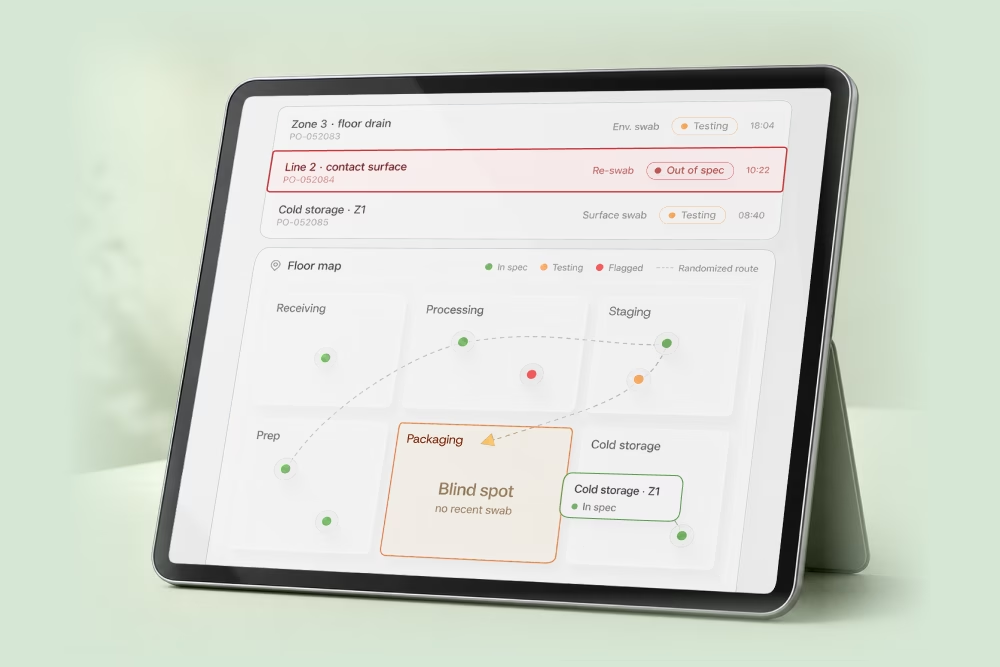
Most environmental monitoring programs follow a fixed schedule. Pathogens do not. Here is why schedule-based EMP creates blind spots, and what a risk-based program does differently.
Your environmental monitoring program runs on a schedule. Swab Zone 1 on Monday. Swab Zone 2 on Wednesday. Rotate through the facility on a fixed calendar.
The schedule looks thorough and on paper, it covers every zone.
Unfortunately, pathogens do not follow a schedule.
A fixed EMP calendar was built for compliance, not for finding risk. It documents that swabbing did happen, but it does not always find what is actually lurking in the dark.
What EMP zones are and why they matter
Environmental monitoring programs divide a facility into zones based on proximity to product contact.
- Zone 1: direct product contact surfaces. This is the highest-risk zone. Examples include conveyor belts, filling equipment, and cutting boards.
- Zone 2: surfaces adjacent to Zone 1. These surfaces do not touch the product directly. But contamination here can transfer to Zone 1. Examples include equipment frames and drip shields.
- Zone 3: areas near the production environment but not adjacent to product contact. Examples include walls, floors near processing lines, and drains.
- Zone 4: areas outside the production environment. Examples include hallways, locker rooms, and loading docks.
Most regulatory guidance and retailer audit standards require sampling in all four zones. The frequency and number of samples differ by zone.
The problem with fixed-schedule EMP
A fixed schedule assigns specific zones to specific days. The team swabs the same locations on the same rotation every week.
However, this approach has a serious flaw because pathogens can adapt to predictable patterns.
Listeria monocytogenes is the most documented example. Studies show that Listeria can establish harborage points in locations that a fixed schedule never hits on consecutive days. The rotation cleans the surface just often enough to suppress the count. But it never eliminates the source.
The result: results come back clean. The harborage point remains.
This is not a failure of the team but a failure of the program design.
A monitoring program that does not find the problem is not a monitoring program. It is documentation.
Four blind spots most EMP programs create
1. Over-sampling safe zones
Fixed schedules often sample low-risk zones more than necessary. Zone 4 locations are easy to access and rarely show positive results. They build a record of clean data. But they do not reduce risk where risk actually exists.
2. Under-sampling high-risk zones
Zone 1 and Zone 2 are the most important areas to monitor. But they are also the hardest to access. Fixed schedules sometimes reduce sampling frequency in these zones because of operational constraints. This creates the highest-risk blind spot in the program.
3. Predictable patterns that pathogens learn
When a fixed schedule always swabs the same location on the same day, the cleaning cycle adjusts to match. Counts stay low enough to pass. The harborage point never triggers a flag. The program shows compliance. The facility is not actually clean.
4. Missing high-risk micro-locations
Floor drains, equipment bases, conveyor junctions, and staging areas are common Listeria harborage points. A fixed schedule often skips these locations or samples them infrequently. They are not labeled as high-risk in the original program design. But experience shows they are.
What a risk-based EMP program does differently
A risk-based EMP program does not replace the schedule entirely. It adds intelligence to the schedule.
Here is what that looks like in practice:
- Risk-weighted zone mapping: sample more frequently in high-risk zones. Reduce frequency in low-risk zones. Base the allocation on historical data, facility layout, and product type, not on what is convenient to access.
- Automated randomization: use a system that randomizes sample locations within each zone. The schedule changes week to week. Pathogens cannot establish a pattern around a predictable rotation.
- Trend analysis: track every result over time by zone, location, and date. Look for patterns. A zone that shows borderline results three times in a row is a signal. A fixed-schedule program rarely surfaces this because the data lives in separate reports.
- Real-time alerts: when a result comes back out of spec, the response begins immediately. Not at the next scheduled review. Not after the weekly report is compiled. Immediately.
- Harborage investigation protocols: when a positive result appears, the program has a defined process for expanding sampling around that location. The goal is to find the source, not just clean the surface.
Together, these elements shift EMP from a documentation exercise to an active risk management tool.
How the data changes what you find
The difference between a fixed-schedule EMP and a risk-based EMP shows up most clearly in what each program finds.
- Fixed-schedule programs tend to find contamination after it has already spread. A positive result in a high-risk zone often means the pathogen has been present for some time. The schedule was not hitting the right location at the right frequency to catch it earlier.
- Risk-based programs tend to find contamination earlier. Randomization and trend analysis surface signals before they become positive results. A borderline pattern in a Zone 2 location triggers investigation before the count crosses the threshold.
Earlier detection means earlier response. Earlier response means less product at risk, fewer corrective actions, and a lower probability that a contamination event becomes a recall.
What to look for in your current program
Review your current EMP program against these questions:
- Does the program sample Zone 1 and Zone 2 at a frequency appropriate to your product risk category?
- Does the schedule randomize sample locations, or does it hit the same spots on the same days every week?
- Do you have a process that tracks results by location over time and flags deteriorating trends?
- When a result comes back out of spec, how long does it take to initiate an investigation?
- Does the program include floor drains, equipment bases, and staging areas as defined sample locations?
If the answer to any of these is no, or uncertain, that is where the blind spot is.
The bottom line
Environmental monitoring is one of the most important tools in food safety. It is also one of the most commonly underbuilt programs in the industry.
A schedule is a starting point. A risk-based program is the actual tool.
The goal is not to document that swabbing happened. The goal is to find what is actually there before it reaches your product.
A program built to find risk is different from a program built to document compliance. Both look the same on paper. Only one works when it matters.