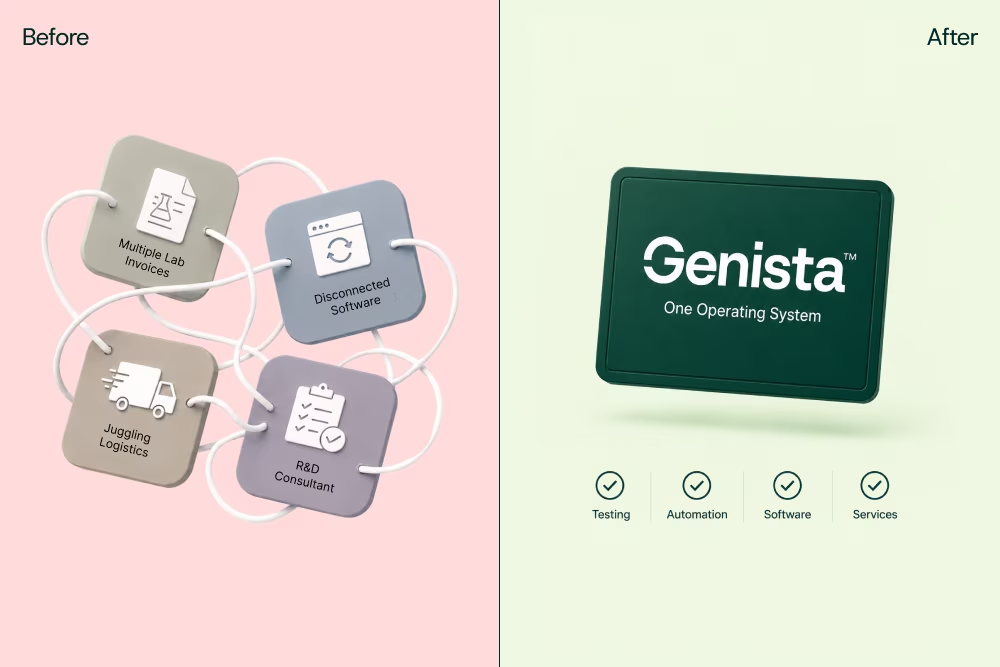
Many mid-size food brands manage their product safety program across three or more vendors.
A typical stack might include a lab for microbiology testing, a different lab for analytical chemistry, a software platform for tracking results, a logistics coordinator for sample pickups, and a consultant for regulatory questions.
Each vendor was chosen carefully. Each fills a legitimate need. Together, they add up to a food safety program that feels comprehensive because it has all the pieces.
What it may not have is a system.
What vendor fragmentation looks like in food safety testing
Vendor fragmentation means a food safety testing program runs through separate labs, software, logistics, and advisors that do not share one record. Fragmentation is rarely a single failure. It is the cumulative effect of building a food safety program piece by piece, vendor by vendor, over time. In practice, it can look like this:
- Results live in multiple portals. Lab A has one login. Lab B has another. The software platform has a third. A complete picture of your testing status means checking three systems by hand, every time.
- Each vendor has a different contact. When something goes wrong, you make calls. The lab contact may not know about the logistics issue. The logistics coordinator may not see the result. Nobody owns the full picture.
- Invoices and contracts multiply. Three vendors means three contracts, three billing cycles, three renewal conversations, and three sets of terms to manage.
- Data does not connect. Results from Lab A are not visible next to results from Lab B. Trend analysis across suppliers, facilities, or time periods needs manual extraction and reconciliation. Many QA teams lack the bandwidth for that, so it does not happen. That is how an environmental monitoring pattern hides in separate reports.
- Response time slows. When a result comes back flagged, the clock starts immediately. In a fragmented system, the first thirty minutes can go to working out who to call, which system holds the relevant history, and whether the logistics vendor can get a re-sample in time.
Each of these problems is manageable alone. Together, they create a program that is slower, less visible, and harder to defend than it needs to be.
Fragmentation feels like thoroughness. That is what makes it easy to miss.
The hidden cost of the scramble
Picture a result flagged on a Friday afternoon. In a fragmented program, the next two hours can look like this:
- Call the lab to understand the result. Wait for a callback.
- Log into the software platform to pull historical results for that supplier. Find that it shows results from only one of your two labs.
- Email the logistics coordinator to learn when the sample was picked up and how it was stored in transit.
- Call the consultant to ask whether the result triggers a regulatory notification obligation.
- Try to build a timeline from four sources that do not talk to each other.
The result itself may be manageable. The two hours spent working out who has which information are operational waste, and in a food safety incident, two hours matters.
Where fragmentation creates documentation and regulatory exposure
The operational costs are significant. The documentation and regulatory risks can be larger.
Chain of custody gaps
Chain of custody is the documented record of how a sample was handled from collection to result. In a fragmented program, it is often split across vendors. The lab holds the analytical record. The logistics provider holds the transport record. If the two are not connected, the chain has gaps. In a recall investigation or an audit, gaps in the sample record can raise questions about the results. A lab with accredited methods and documented custody closes part of that gap, but only if the records stay linked.
Audit documentation scrambles
When a retailer or regulator asks for documentation, a fragmented brand must pull records from several systems and reconcile formats. Time limits are real. FDA’s preventive controls rule lets a facility store records offsite only if they can be retrieved onsite within 24 hours of a request. For foods on the Food Traceability List, FSMA 204 will generally require records within 24 hours from its July 2028 compliance date. Records spread across systems can turn that window into days. A documentation request is easier to answer when the data is in one place.
Institutional knowledge risk
In a fragmented program, the person who knows how everything connects is often a single QA manager or director. They know which lab handles which products, which software fields map to which test types, and which vendor to call in which scenario. When that person leaves, the knowledge leaves with them. A connected system keeps it in the record.
Why fragmentation persists
If fragmentation creates this many problems, why is it so common?
It is the path of least resistance. Every vendor in a fragmented stack was added to solve a specific problem at a specific moment. The microbiology lab was added when the brand started selling into retailers that required micro testing. The analytical chemistry lab was added when supplement label claims needed validation. The software platform was added when the spreadsheets got unmanageable.
Each addition made sense in context. Nobody sat down and designed a fragmented system. It assembled itself, one reasonable decision at a time.
The result is a program where “good enough” at each step adds up to “not good enough” for the system as a whole.
What a connected system changes
A connected food safety system is one where testing, software, logistics, and managed services operate as a single integrated platform. It reduces administrative friction, and it changes the risk profile of the program.
- One chain of custody. Each sample and lot has one record that holds the result, method, COA, chain of custody, and corrective action, with no reconciliation between vendors.
- One data layer. Results are visible in one connected system. Trend analysis, supplier performance tracking, and environmental monitoring history are available without manual extraction.
- One point of contact. When something goes wrong, there is one call to one team that owns the full picture. Response time can be measured in minutes.
- One audit trail. When a retailer or regulator asks for documentation, it sits in one place, in one format, ready to export.
- One monthly flat fee. Shipping, supplies, and retests are included, so there are no billing reconciliations or surprise invoices. See the cost breakdown for how this compares with a fragmented program.
Brands that make this shift often describe it as getting their QA team’s time back.
The bottom line
Fragmentation feels like flexibility. In practice, it is the accumulation of risk across every seam where your vendors do not connect.
Your vendors may each be good at what they do. The open question is whether the system they form is fast, visible, and defensible enough for the program your brand needs. A recall tests that question quickly.
For many mid-size food brands, the honest answer is no. The pieces may be fine. The system is the gap.
Genista is the operating system for product safety, with accredited testing, robotic automation, connected software, and services in one closed loop, instead of stitching together 3+ vendors.
Want to see what one connected system looks like for your program?