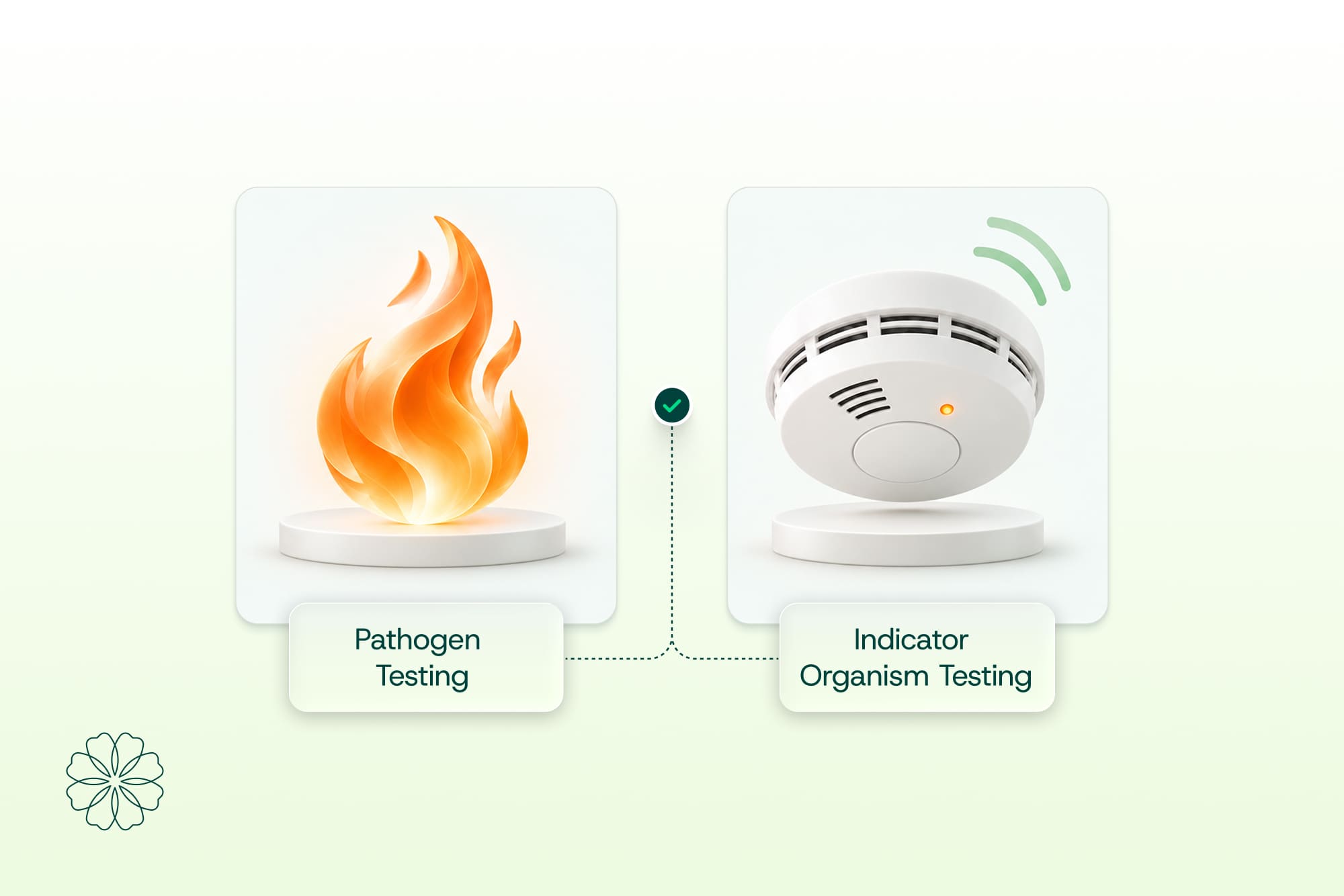
Pathogen tests and indicator tests are both forms of food microbiology testing. They answer different questions.
Pathogen testing asks: is this product, ingredient, or surface contaminated with a specific disease-causing organism?
Indicator organism testing asks: is my process under control? It looks for organisms that are not the pathogen you worry about, but that are easier to find and show up more often when sanitation, handling, or process control slips. Examples include the organisms counted in an aerobic plate count, coliforms, and Enterobacteriaceae. They point to sanitation, handling, or process problems.
Think of an indicator test as a smoke detector. It does not look for the fire itself. It tells you conditions may allow one. And like a smoke detector, it can sound without a fire, so the right response is to investigate. A pathogen test is the one that looks for the fire itself.
In short, use indicator organism testing to verify that sanitation and process controls are working, and use pathogen testing when a raw ingredient, a new supplier, a rule, or an indicator signal calls for direct confirmation. A negative result from either test describes only the samples tested.
FDA’s preventive controls rule names both. It lists product testing for a pathogen or an appropriate indicator organism as a verification activity, and environmental monitoring for an environmental pathogen or an appropriate indicator. The rule leaves the choice to you. A program works best when it knows which question each result answers.
What each test tells you
Pathogen testing
- It tests for a named organism, such as Salmonella, Listeria monocytogenes, or Shiga toxin-producing E. coli.
- A positive is a serious finding. The National Advisory Committee on Microbiological Criteria for Foods (NACMCF) says a pathogen-contaminated product signals an overt loss of process control.
- A negative only describes the samples tested. When a system is under control, pathogens are unlikely, unevenly distributed, and may sit at levels that are hard to detect. In one FAO example, a plan that tests five samples and accepts a lot if none are positive would accept a lot with 10 percent contaminated samples about 59 percent of the time.
Indicator organism testing
- It counts organisms that appear more often and in larger numbers than pathogens. In product, examples are aerobic plate count, Enterobacteriaceae, coliforms, and mold. In the environment, they are Listeria species and Enterobacteriaceae.
- A high result does not mean a pathogen is present. A trend of out-of-range results calls for investigation.
- Trends can show that controls need correction before pathogens become a problem.
- A clean indicator count describes conditions. It does not show that a lot is free of pathogens.
Process control is not lot acceptance
NACMCF separates two uses of testing. Lot testing examines a lot you know little about, such as an ingredient from a new supplier, and it needs many samples. Process verification takes a few samples from many lots, on a regular schedule, to show that controls are working.
FDA has said that product testing under the preventive controls rule is a verification activity. It is not a way to establish that every lot is acceptable.
Hold-and-release testing can find high rates of contamination. It is not very effective when a system is under control, or when contamination is rare.
When to use pathogen testing
- New or unproven ingredients and suppliers. NACMCF recommends that customers periodically test supplier ingredients to verify the supplier’s controls, even when a COA comes with each shipment. See Your Supplier Says It’s Safe. But Who’s Checking?
- Raw foods with no kill step, and foods handled after one. NACMCF lists untreated spices, fresh fruit and vegetables, nuts, sandwiches, and deli salads as cases where verification testing is appropriate.
- A periodic check of finished product. For foods with a reduction step that are exposed to the environment before packaging, NACMCF suggests pathogen testing of finished product as a periodic check, such as quarterly or as risk assessed.
- A signal from monitoring. If environmental monitoring suggests cross-contamination, NACMCF says to test more often, and to hold and test the implicated product with a statistically based sampling plan and a validated method.
- A rule that requires it. For example, powdered infant formula must be tested for Cronobacter and Salmonella under 21 CFR 106.55, as NACMCF notes.
Short shelf life changes the picture. For foods such as cut melon and deli salads, results may arrive after the product is past its date. NACMCF says supplier controls and environmental monitoring work better there than finished product pathogen testing.
When to use indicator testing
- Routine process verification. For foods with a reduction step that are exposed to the environment before packaging, NACMCF says lot testing for indicator organisms is frequently the primary verification of process control.
- Sanitation and environmental monitoring. FDA’s draft Listeria guidance recommends testing for Listeria species. A positive does not confirm L. monocytogenes, but it shows conditions where it can survive. See EMP zone mapping.
- Trending. NACMCF says to analyze indicator counts and positive environmental results for trends, and to use them to set and adjust limits and responses.
- Shelf life and quality. Spoilage organisms can verify shelf life, and counts that rise can show a change in ingredients or sanitation.
One federal rule shows both jobs. Under 9 CFR 310.25, meat slaughter plants test generic E. coli to verify process control, and USDA samples for Salmonella against a pathogen performance standard.
Using them together
The two tests work as a pair. An indicator result raises a flag. A pathogen test confirms or rules out contamination when the flag calls for it.
NACMCF gives an example. A low water activity bar shows out-of-range coliforms at several points in a run. The team reviews sanitation, checks coliform levels in ingredients, considers a pathogen test of finished product, and decides what to do with the product.
Codex advises that where a pathogen can be detected directly and reliably, you should consider testing for it in preference to an indicator. Indicators earn their place where pathogens are rare, uneven, or hard to detect.
A positive pathogen result after shipment is a different problem. It raises the question of whether the product has left your control, and recall costs build quickly.
Questions to ask about your current program
- Does your product get a validated kill step, and is it exposed to the environment afterward?
- Does the food support pathogen growth, and how long is it stored?
- Is it made for higher-risk consumers, such as infants?
- How does your shelf life compare with the time it takes to get results?
- Which pathogen and which indicator are relevant to this food?
- Is the method validated for your product, and is it inside the lab’s accredited scope?
If you cannot say which question each of your tests answers, start there.
The bottom line
Pathogen tests and indicator tests answer different questions. A program that asks only one of them can leave the other unanswered.
Use indicators to watch the process. Use pathogen tests where the risk, the rule, or a signal calls for them.
Genista’s ISO/IEC 17025 accredited scope covers both. Pathogens by real-time PCR include Salmonella, Listeria monocytogenes and Listeria species, Shiga toxin-producing E. coli, and Campylobacter. Indicator methods include aerobic plate count, coliforms, Enterobacteriaceae, and yeast and mold. With next-day results on most tests, an indicator flag can lead to a pathogen follow-up quickly.
Genista is built for this: One operating system for product safety, with accredited testing, robotic automation, connected software, and services in one closed loop, instead of stitching together 3+ vendors.
Want to see how pathogen and indicator testing fit your products? Book a Meeting →