“Allergen-free” is a promise to the one group of buyers who cannot afford a wrong answer.
That promise is easy to print and hard to prove.
Many brands believe they meet it because they do not put the allergen in the recipe. That is not enough. The risk is the allergen you did not add.
The stakes are high. In 2025, undeclared allergens were the most common cause of FDA and USDA food recall announcements, at 39% in PIRG Education Fund’s analysis of federal data. Recall costs build quickly.
No U.S. rule sets an allergen level for a “free” claim, and the FDA’s draft guidance expects a product with that claim to contain none of the allergen. To defend the claim, a brand needs a test method validated for its product, testing at the points where cross-contact can occur, and records it can produce on request.
What the FDA says about “free” claims
The FDA lists nine major food allergens: milk, egg, fish, crustacean shellfish, tree nuts, wheat, peanuts, soybeans, and sesame.
Labeling law covers allergens that are ingredients. An allergen that gets in by accident is called cross-contact. It does not go on the ingredient list. Instead, the preventive controls rules apply. A facility must have controls that prevent or significantly minimize cross-contact.
An “allergen-free” claim is voluntary. Gluten-free is the one claim with a legal definition. For every other allergen, no rule sets a level that a product must meet to say “free.”
That does not make the claim easy. The FDA says a “free” claim must be truthful and not misleading. In its draft guidance for FDA staff, issued in May 2023 and not yet final, it says a product labeled “milk-free” should contain no milk allergen. The FDA has also not set a threshold for any major allergen.
If a food carries an allergen-free claim and testing suggests it contains that allergen, the FDA may treat the label as false or misleading.
So the claim has no built-in margin: “free” means free.
Where cross-contact comes from
Cross-contact does not need a visible mistake. The FDA’s draft guidance names four common causes: shared equipment that is not cleaned well enough, allergens that are not kept apart, rework added the wrong way, and production runs scheduled in the wrong order.
Ingredients carry risk too, and the draft guidance points to weak controls on ingredient and product storage, handling, and use. Independent verification of supplier ingredients is one way to check.
A “may contain” statement does not fix any of these. The FDA says advisory statements are not a substitute for good manufacturing practices and preventive controls. It may treat a product as adulterated when controls are inadequate, even if the label has an advisory statement.
What proof looks like for an allergen-free claim
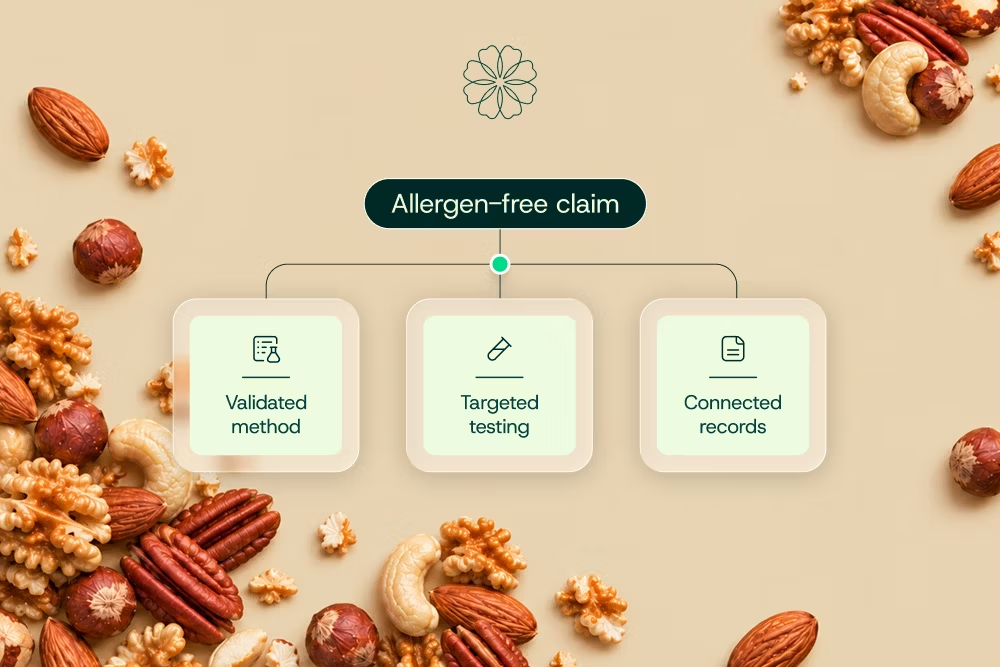
A claim you can defend depends on three things.
1. A method validated for your product. Allergen tests do not work the same way in every food. Common methods include ELISA, PCR, and mass spectrometry. Processing and the food matrix can change how well an allergen can be detected. The UK Food Standards Agency’s review of allergen testing methods calls for reference materials prepared in a range of food matrices to account for matrix interference and processing. For incident investigations, where the level of processing is unknown, the review recommends a workflow of complementary tests, typically one to three, rather than a single test. Ask your lab how it chose the method for your product, whether the method is validated for that food, and how it confirms a result. Check that the lab’s accredited scope covers the method.
2. Testing at the right points. One finished-product test is not enough. An allergen can spread unevenly in a product, so one sample can miss it. Test the ingredients that carry risk. Swab surfaces after cleaning. Test finished product at a frequency that matches the risk.
3. Results you can produce on request. When it reviews an allergen case, the FDA collects the test result, the method, the sample description, and the lot information. A retailer or an auditor may ask for the same evidence. Keep the result, method, sample, lot, and chain of custody in one place.
The draft guidance does not say which tests a brand must run. The brand decides, based on its own risk. That is why the plan matters more than any single result.
Where programs fall short
- A cleaning log with no test to show that the cleaning worked
- Finished-product testing only, with no ingredient or surface testing
- A test method that was never checked against the product
- A “may contain” statement used in place of a control
- Results spread across lab portals and email, so the proof can take days to assemble
A cleaning log shows that cleaning happened. It does not show that it worked.
What a connected program changes
In a connected program, results, methods, lots, and chain of custody sit in one system. When a retailer asks for the evidence behind a claim, you answer in minutes.
The same record also supports your next decision. When a supplier or a formula changes, you can check the allergen risk against your plan and your past results.
Questions to ask about your current program
Before your next audit or label change, answer these questions:
- Which allergens are on your site, and which products share lines with them?
- When did you last verify that cleaning removed each allergen?
- Is each test method validated for your product?
- Do you test ingredients and surfaces, or finished product only?
- If a retailer asked for the evidence behind your allergen-free claim today, how long would it take?
If you cannot answer one of these quickly, start there.
The bottom line
An allergen-free claim has no built-in margin. The FDA’s draft guidance expects the product to contain none. The proof is a plan, a validated method, and records you can produce.
Genista is built for this: one operating system for product safety, with accredited testing, robotic automation, connected software, and services in one closed loop, instead of stitching together 3+ vendors.
Our ISO/IEC 17025 accredited scope covers allergens including milk, egg, fish, shellfish, tree nuts, wheat, peanut, soybean, and sesame, tested by ELISA and real-time PCR, plus gluten and gliadin by ELISA.
Want to see how a connected program proves an allergen-free claim? Book a Meeting →