Most food brands don’t think of their food safety program as fragmented. They think of it as thorough. Here’s why those two things aren’t the same — and what fragmentation actually costs.
The average mid-size food brand manages its product safety program across three to five separate vendors.
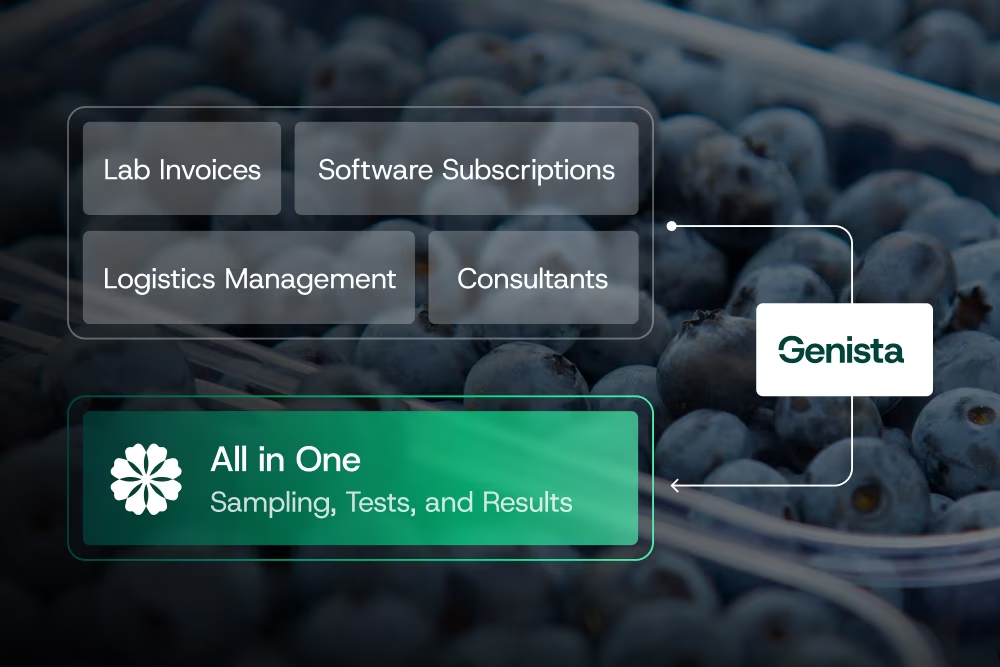
A lab for microbiology testing. A different lab for analytical chemistry. A software platform for tracking results. A logistics coordinator for sample pickups. A consultant for regulatory questions.
Each vendor was chosen carefully. Each fills a legitimate need. And together, they add up to a food safety program that feels comprehensive because it has all the pieces.
What it doesn’t have is a system.
What fragmentation actually looks like
Fragmentation isn’t a single failure. It’s the cumulative effect of building a food safety program piece by piece, vendor by vendor, over time.
Here’s what it looks like in practice:
- Results live in multiple portals: Lab A has one login. Lab B has another. The software platform has a third. Getting a complete picture of your testing status means checking three systems — manually, every time.
- Each vendor has a different contact: when something goes wrong, you’re making calls. The lab contact doesn’t know about the logistics issue. The logistics coordinator doesn’t have visibility into the result. Nobody owns the full picture.
- Invoices and contracts multiply: three vendors means three contracts, three billing cycles, three renewal conversations, and three sets of terms to manage. Administrative overhead that compounds over time.
- Data doesn’t connect: results from Lab A aren’t visible alongside results from Lab B. Trend analysis across suppliers, facilities, or time periods requires manual data extraction and reconciliation. Most QA teams don’t have bandwidth for that — so it doesn’t happen.
- Response time slows: when a result comes back flagged, the clock starts immediately. In a fragmented system, the first thirty minutes are spent figuring out who to call, which system has the relevant history, and whether the logistics vendor can get a re-sample in time.
Each of these problems is manageable in isolation. Together, they create a food safety program that is slower, less visible, and harder to defend than it needs to be.
Fragmentation doesn’t feel like a risk. It feels like thoroughness. That’s what makes it dangerous.
The hidden cost of the scramble
The most visible cost of fragmentation shows up in a crisis. A result comes back flagged on a Friday afternoon. Here’s what the next two hours look like in a fragmented program:
- Call the lab to understand the result. Wait for a callback.
- Log into the software platform to pull historical results for that supplier. Realize the platform only shows results from one of the two labs you use.
- Email the logistics coordinator to find out when the sample was picked up and how it was stored in transit.
- Call the consultant to ask whether this result triggers a regulatory notification obligation.
- Attempt to piece together a timeline from four different sources, none of which talk to each other.
The result itself may be manageable. The two hours spent figuring out who has what information is pure operational waste — and in a food safety incident, two hours matters.
Where fragmentation creates legal and regulatory exposure
The operational costs are significant. The legal and regulatory costs are potentially worse.
Chain of custody gaps
In a fragmented program, chain of custody — the documented record of how a sample was handled from collection to result — is often split across vendors. The lab has the analytical record. The logistics provider has the transport record. If they’re not connected, the chain has gaps. In a recall investigation or FDA audit, those gaps are findings.
Audit documentation scrambles
When a retailer or regulator requests documentation, the fragmented brand has to pull records from multiple systems, reconcile formatting differences, and hope nothing falls through the cracks. What should take an hour takes three days. During that window, the brand looks unprepared — because operationally, it is.
Institutional knowledge risk
In a fragmented program, the person who knows how everything connects is usually a single QA manager or director. They know which lab handles which products, which software fields map to which test types, and which vendor to call in which scenario. When that person leaves — and eventually they will — that knowledge leaves with them. A connected system retains it automatically.
Why fragmentation persists
If fragmentation creates this many problems, why is it so common?
The honest answer: it’s the path of least resistance. Every vendor in a fragmented stack was added to solve a specific problem at a specific moment. The microbiology lab was added when the brand started selling into retailers that required micro testing. The analytical chemistry lab was added when supplement labeling claims needed validation. The software platform was added when the spreadsheets got unmanageable.
Each addition made sense in context. Nobody sat down and designed a fragmented system. It assembled itself, one reasonable decision at a time.
The problem is that “good enough” at each step produces “not good enough” at the system level.
What a connected system actually changes
A connected food safety system — one where testing, software, logistics, and managed services operate as a single integrated platform — doesn’t just reduce administrative friction. It changes the fundamental risk profile of the program.
- One chain of custody: every sample has a single, unbroken record from pickup to result. No gaps, no reconciliation, no missing documentation.
- One data layer: results from every test type are visible in a single platform. Trend analysis, supplier performance tracking, and environmental monitoring history are available without manual extraction.
- One point of contact: when something goes wrong, there is one call. One team that owns the full picture. Response time is measured in minutes, not hours.
- One audit trail: when a retailer or regulator asks for documentation, it’s in one place, in one format, ready to export. Audit readiness isn’t a project — it’s a default state.
- One monthly flat fee: no contract proliferation, no billing reconciliation, no renewal cycle management. Predictable cost, predictable scope.
The brands that have made this shift don’t describe it as a technology upgrade. They describe it as getting their QA team’s time back.
The bottom line
- Fragmentation feels like flexibility. In practice, it’s the accumulation of risk across every seam where your vendors don’t connect.
- The question isn’t whether your current vendors are good at what they do individually. Most of them probably are. The question is whether the system they form together is good enough — fast enough, visible enough, defensible enough — for the program your brand actually needs.
For most mid-size food brands, the honest answer is no. Not because the pieces are wrong, but because pieces aren’t a system.